
News
Palaeography Teaching in Scotland
As a long-established scholarly record society, the Scottish Record Society has an interest in the teaching of palaeography skills. While an unknown number of Higher Education (HE) and Heritage institutions in Scotland, for example archives, libraries, museums and other societies, provide training and resources, there is no one format or standard for palaeography tuition. More importantly, good practice in one archive or classroom might not be known to others undertaking palaeography teaching, which reduces its impact. If such skills and good practice are not consciously supported and encouraged, fewer people will undertake to learn them, which means there will be less access to manuscript records for all.
The SRS Council has approved funding for a study of the teaching of palaeography in Scotland in universities, colleges, public institutions and communities, and what teaching tools and resources are available. We envisage two main outputs: a public symposium on the subject, and a journal article describing the findings. We expect to provide a three-month grant to a suitably qualified researcher, probably someone at postdoctoral level or beyond. They would engage with as many parties involved in the field as possible, organise the symposium and report their findings. A job description will shortly be advertised on jobs.ac.uk.
Volumes published in December 2025
Two very different volumes were published for 2025:
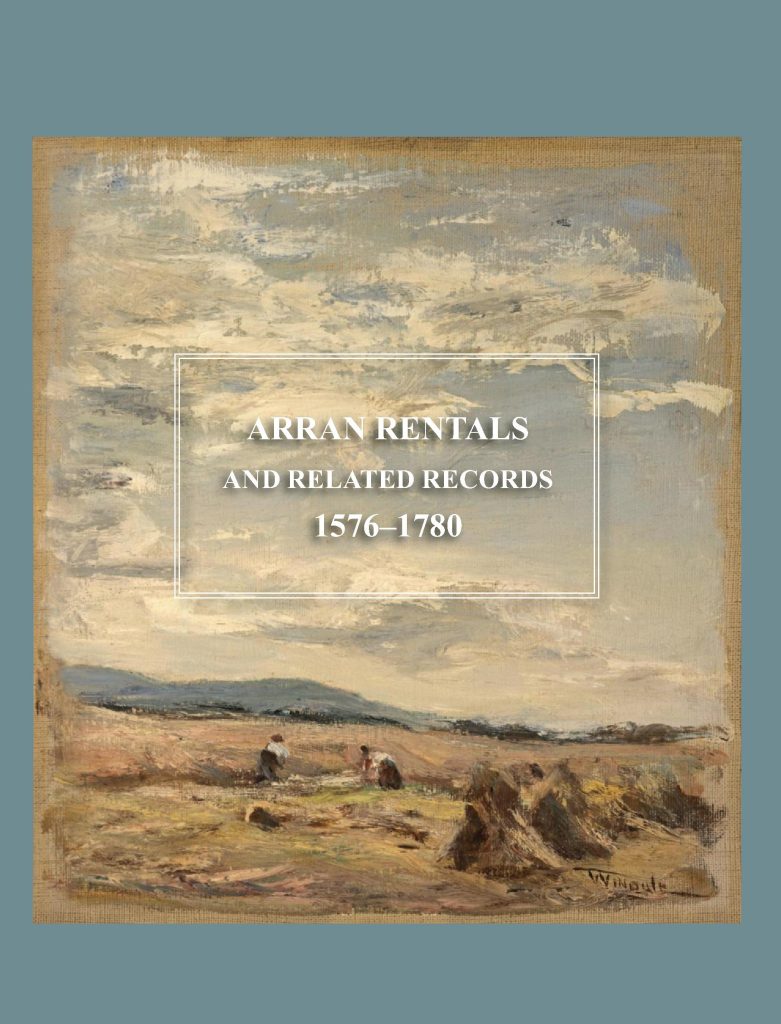
New Series 51, Arran Rentals and Related Records, 1576-1780, edited by Robert H J Urquhart, offers transcriptions of original records relating to early-modern Arran, sometimes difficult to consult. A selection of rentals and other estate papers between the mid-sixteenth and mid-eighteenth centuries, from the archives of the dukes of Hamilton and Brandon and other repositories, are transcribed, along with a calendar of wills and testaments and other commissary court records relating to Arran before 1780. Together they provide details of the people, places, ecology, landscape and everyday life on the island between the medieval and modern eras.
294 pages, 215x150mm, 2025, ISBN 978-0-902054-09-7, non-members’ price £25.
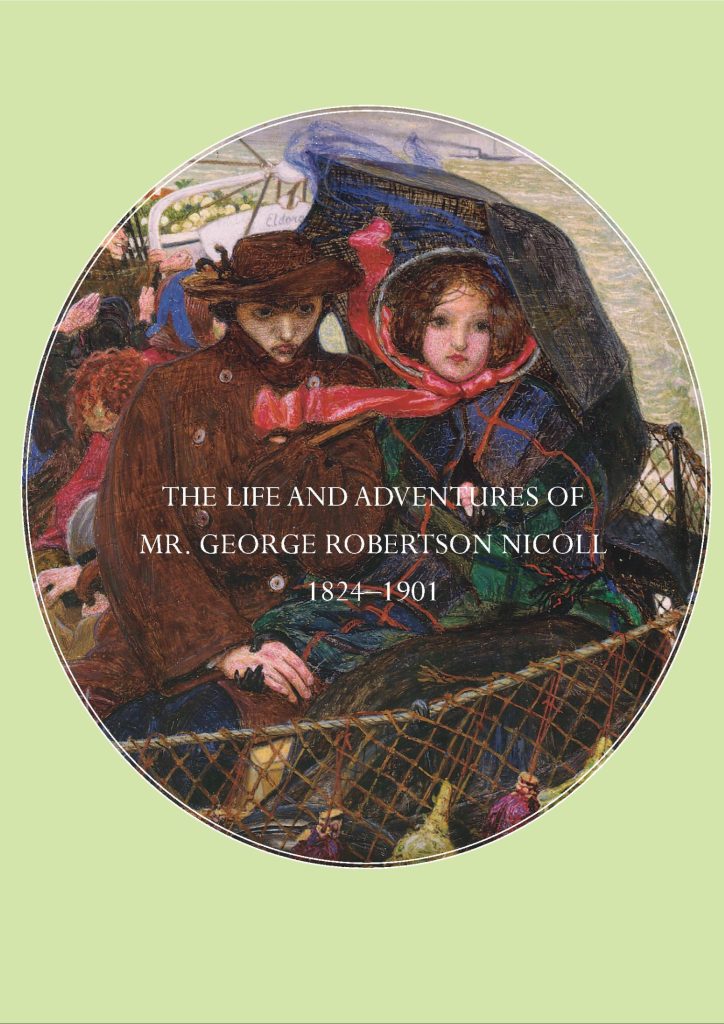
New Series 52, The Life and Adventures of Mr George Robertson Nicoll, 1824-1901, edited by Viviene Cree, describes in his own words the life of George Robertson Nicoll, born in Dundee, who, in 1848, first set off as an assisted immigrant at the age of 24 with his wife and infant son for a new life in New South Wales. He was a carpenter and shipwright, in particular a block and pump maker, and used his skills in harbours, gold mines, farming and coastal trading. In retirement, he became a keen world traveller. His experiences are fresh, at times exciting, and show a strong sense of the values instilled in him by his Dundee upbringing. He remained faithful to Scotland, returning often to visit friends and family and to commission the building of steamships. His travels show the changing pattern of voyaging in the latter part of the 19th century and reflect the growth of European interest and understanding of the wider world.
416 pages, 215x150mm, 2025, ISBN 978-0-902054-11-0, non-members’ price £25.
Volume published in 2024:
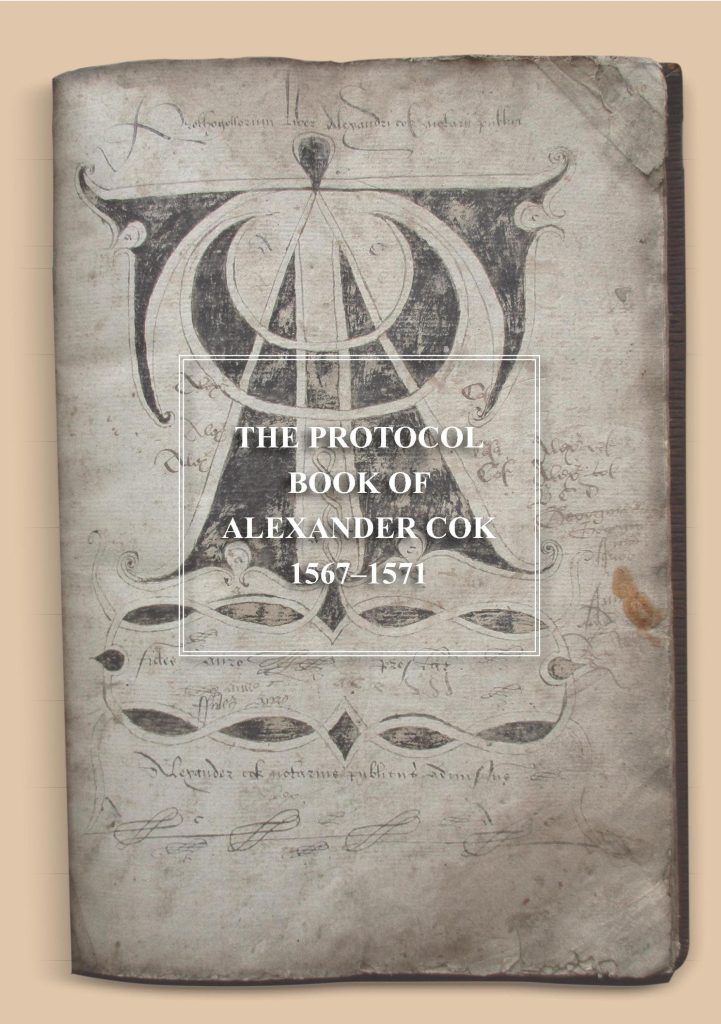
New Series 50, The Protocol Book of Alexander Cok, 1567-1571, edited by Iain Flett, is a transcription of the Protocol Book of a Fife Notary Public, Alexander Cok, whose duties in this case included acting as town clerk on behalf of the burgh of Kirkcaldy. The business transacted dealt exclusively with the burgh court and so the survival of this volume is the nearest thing we have to a burgh court book. At a time when perhaps the population was about one and a half thousand, its detailed account of pursuit of debts, pursuit of widows’ possessions by grasping relatives, and its establishment of common rule at annual Head Courts, tells a unique everyday story of burgh folk.
178 pages, 215x150mm, 2024, ISBN 978-0-902054-07-3, price £40.
Scottish Medievalists’ Conference January 2024:
The Scottish Medievalists’ have graciously sent this link to the Duncan Lecture Alan Macquarrie gave at their conference in January, with the following remarks:
Alan Macquarrie has kindly given permission for the recording of his Duncan Lecture to be circulated. We hope you enjoy what was a terrific paper:
(please note, however, that the transcript has been automatically generated and has not been corrected – please ignore any resulting robot nonsense)
Volume 49, New Series

The Calendar of Scottish Supplications to Rome IX, 1534-1549
The volume for 2023, New Series 49, is edited by Alan Macquarrie and continues the series of the Calendar of Scottish Supplications to Rome whose first volume appeared under the imprint of the Scottish History Society in 1934; it covers the pontificate of Pope Paul III, 1534-1549. It is based on a draft MS calendar prepared by the late Dr Tom Graham as part of his PhD research under the direction of the late Professor Ian B Cowan at Glasgow University in the 1970s and 1980s, which is here filled out and completely re-edited from the originals in the Vatican Archives.
The Calendar shows the day-to-day working of the Papal chancellery in respect of benefice-hunting and litigation by Scottish clerics. The disturbed state of the kingdom and the misery caused by England’s ‘rough wooing’ of the 1540s, the rebellion by Matthew earl of Lennox and his brief occupation of Glasgow in 1544, and the destruction of the nunnery of Eccles by the Earl of Hertford in 1545, are all mentioned. James V’s rapacious demands, heresy, nepotism and clerical misconduct also feature. The evidence presented here helps to fill in some of the detail of our picture of the Scottish church in the years leading up to the Reformation.
Alan Macquarrie will deliver the AAM Duncan Memorial Lecture at the Scottish Medievalists’ Conference on Saturday 6 January on the subject of the Calendar of Papal Letters to the British Isles and the Calendar of Scottish Supplications to Rome, entitled A Tale of Two Series. Meanwhile, volume 49 is already on display in the Vatican Library’s new books:

Volume 48, New Series
 The Work Journals of William Dickson 1717-1745
The volume for 2022, New Series 48, arises from the researches of the 1722 Waggonway Heritage Group into the archaeology and history of a wooden wagonway that ran from the coal mines of Tranent to the harbour and salt pans of Cockenzie and Port Seton and dates to the first half of the eighteenth century. It is an important aspect of the local area’s heritage and Scotland’s early industrialisation. In exploring what records were held relating to the wagonway, Group members discovered a description of the ‘Journals of William Dickson’ in the National Records of Scotland’s digital catalogue and undertook to transcribe them, releasing a wealth of information relating to the research in which the 1722 Waggonway Heritage Group was concerned. William Dickson was a carpenter and joiner by trade, and his journals, or day books, list his time spent and materials used and give some picture of the society in which he moved and worked. The Scottish Record Society is publishing the Group’s transcription of the Journals to coincide with the 300th anniversary of William Dickson’s work on Scotland’s first railway.
For further information on the 1722 Waggonway Heritage Group, see www.1722waggonway.co.uk
P.S., the 1722 WHG has a short YouTube on further possibilities for exploration in the vicinity of the railway, at https://youtu.be/MIXNYz8NRS0.
George MacKenzie, President of the Scottish Record Society, gave as his Address for 2021 a paper on the second part of his researches into the Warings of Lennel. Please click on the title above to download a pdf.
The first part of the President’s researches, delivered in 2019.
Scottish Indexers
Our Treasurer, Tessa Spencer, gave a talk at the Scottish Indexes Conference on September 4, a guided tour with examples of the kinds of records to be found in the National Records of Scotland. The website www.scottishindexes.com has a link to the talk, see https://www.scottishindexes.com/pastconferences.aspx#c12.
Volume 47, New Series

The volume for 2021, New Series 47, is the Calendar of Scottish Supplications to Clement VII and Benedict XIII of Avignon 1378-1419, edited by Monsignor Charles Burns and Alan Macquarrie. This is a preliminary addition to the Calendar of Scottish Supplications to Rome series, whose first volume appeared under the imprint of the Scottish History Society in 1934. It covers the period of the Avignon popes of the Great Schism, 1378-1419, to whom Scotland was unswervingly loyal. This is the first complete and chronological calendar of the Scottish supplications for this period, when Scotland was mostly under the governorship of the enigmatic Robert, Duke of Albany (d. 1420). Among many points of interest are letters from Scotland’s first cardinal, Walter Wardlaw, who died in 1387, and supplications for the erection of Scotland’s first university at Saint Andrews in 1412.
SRS Online
The SRS has formally agreed to the online publication of the Society’s backlist as searchable text in a subscription database administered by our existing ebook publishers, TannerRitchie. The database, which is expected to become available later in 2021, will allow researchers to carry out structured text searches of volumes, with the facility to search across multiple volumes at once. We hope that this will prove a useful platform for accessing, navigating and using Scottish Record Society publications, for members and non-members, and that it will allow the Society to continue to fulfil our aim of promoting the study of Scotland’s historical records.

The print volume for 2020, New Series 46, is An Impartial and Genuine List of the Ladys on the Whig or Jacobite Partie, Edinburgh 1745, transcribed and edited by Anita R Gillespie. The List, or rather Lists, is a series of names of mostly young and unmarried ladies compiled by two Whig gentlemen in Edinburgh in 1745-6 as a counter to the perceived imbalance of Jacobite propaganda of that time. It casts an unusual and personal light on the inhabitants of Edinburgh, in a way not seen in many contemporary accounts.

Also published in 2020 is the Society’s second electronic-only book, Scottish Agricultural Implement and Machine Makers 1843-1914: a directory, by Heather Holmes. This is a survey of the agricultural implement and machine makers in Scotland between 1843 and 1914. It is proving a valued resource for people interested in Scottish rural and agricultural history as well as Scottish industrial and engineering history.
Fasti Ecclesiae Scoticanae Medii Aevi Ad Annum 1638 – Third Edition of the New Series volume 25, edited by Norman Shead and the late D E R Watt and A L Murray, is now available as an electronic book.
This is a very full and comprehensive revision of one of our most valuable and well-used publications. Norman Shead has painstakingly updated and completed it, following on the work begun but sadly not finished by the late Athol Murray.
Please remember that no copies or onward distribution may be made of any electronic titles belonging to the Scottish Record Society without the permission of the Society. All funds received by the Society go to support our mission of publishing documents of record relating to Scotland.
Recent print volumes are:


2019: New Series 44 and 45, Borland’s Fowler: an annotated copy of Fowler’s Paisley and Johnstone Commercial Directory 1841-42, edited by John Malden, and Galston Kirk Session Register, Baptisms, Marriages, Poor’s Accounts, 1568-1595, edited by Margaret H B Sanderson.